
Salesforce Career Guide 2026: Roles, Certifications, Fees, Jobs and Salaries in Pune

In short
Salesforce is not one career — it is eight. This guide maps each path to the background it suits (BE/BTech, BCom, MBA, Java developer, marketer), with Pune fee bands, certification facts, salary ranges and roadmaps.
Salesforce is not one career — it is eight. This guide maps each path to the background it suits (BE/BTech, BCom, MBA, Java developer, marketer), with Pune fee bands, certification facts, salary ranges and roadmaps.
Salesforce is one of the world's most widely deployed cloud CRM platforms, and in Pune it is one of the few enterprise skills that hires both programmers and non-programmers into the same ecosystem. That is the single most misunderstood thing about it.
Most students arrive with the wrong question — "Which Salesforce course should I join?" The better question is "Which Salesforce role fits my background?", because the ecosystem now spans administration, automation, development, integration, analytics, data, marketing, consulting and AI agents. Each of those is a different job with a different entry barrier.
This guide answers that question properly: what Salesforce is, which path suits which background, what the certifications actually are, what training costs in Pune, what salaries look like, who hires here, and the month-by-month roadmaps for each starting point.
What is Salesforce?
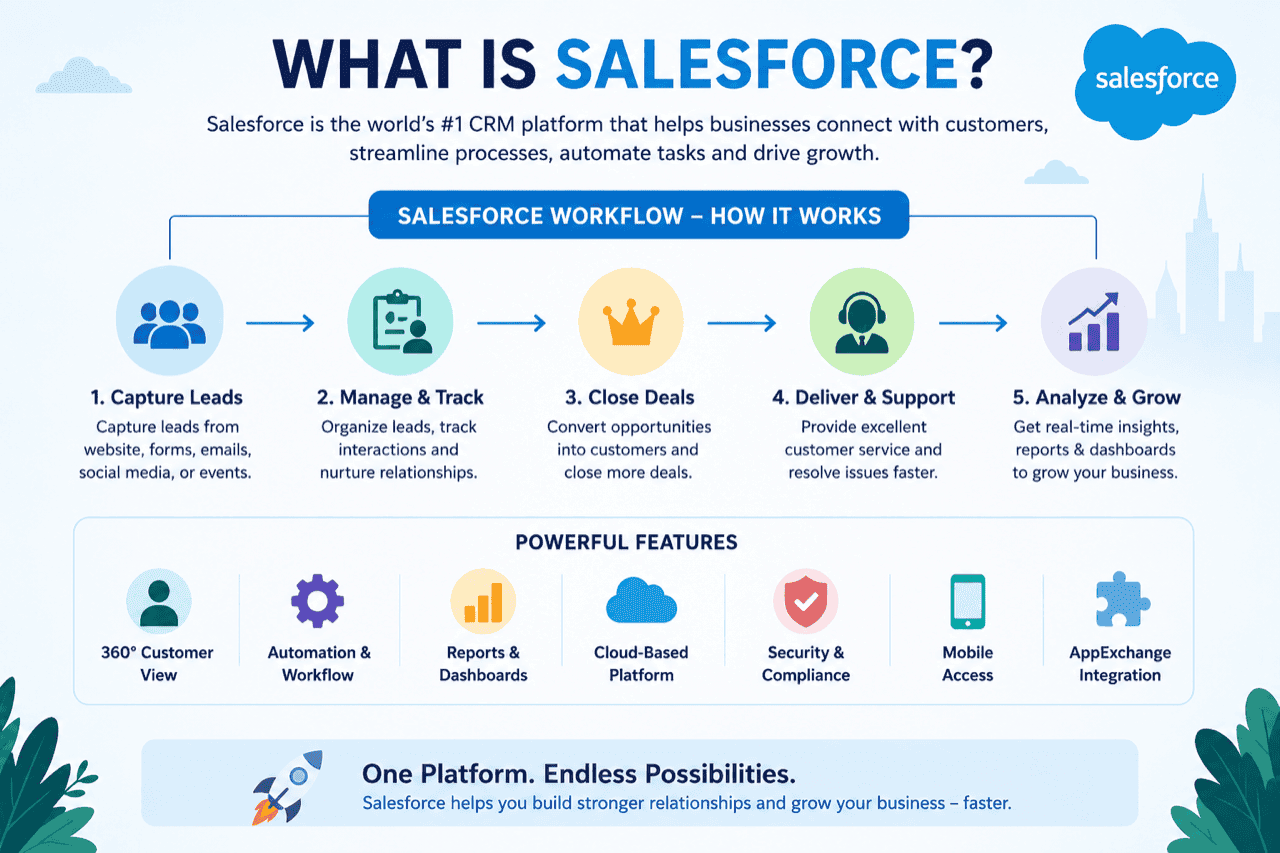
Salesforce is a cloud-based Customer Relationship Management (CRM) and enterprise application platform. Organisations use it to capture leads, manage customers and opportunities, run service and marketing operations, automate business workflows, report on everything, and increasingly to run AI agents on top of their customer data.
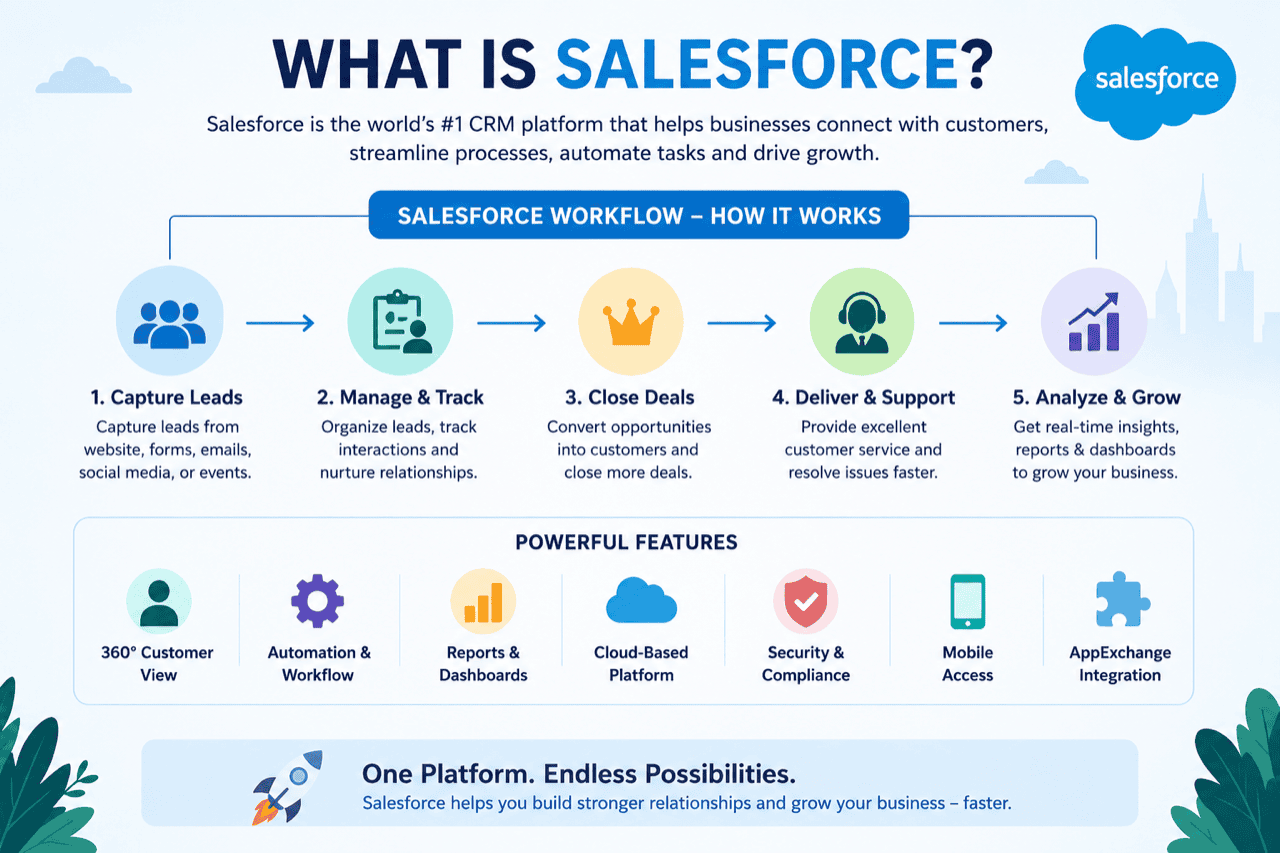
The commercial advantage — and the reason the job market exists — is that companies can build and customise business applications on Salesforce without developing every component from scratch. Configuration replaces a large share of what would otherwise be custom code, which is exactly why the platform employs so many people who don't write code.
Salesforce in plain language
Picture a company with thousands of customers. It needs to know who they are, which leads are likely to buy, which sales rep owns each lead, what stage every opportunity is at, which customers have open support problems, which campaigns are generating business, what management sees on a dashboard, which tasks can be automated, and where AI can help. Salesforce is the platform that holds all of that in one place.
Why "Salesforce career" is not one career
A modern Salesforce professional may work with any combination of Sales Cloud, Service Cloud, Marketing Cloud, Experience Cloud, Commerce Cloud, the core Platform, Apex, Lightning Web Components (LWC), APIs and integration, Data Cloud, Tableau, Agentforce, automation, DevOps, security and architecture.
That breadth is why the same platform can employ a BCom graduate as an Administrator and a BTech graduate as an Apex developer — and why picking the wrong entry path wastes six months.
Which Salesforce path fits your background?
This is the table to read first. Find your row, and read the rest of the guide with that path in mind.
| Your background | Recommended starting path | Coding requirement |
|---|---|---|
| BE/BTech CS/IT | Salesforce Developer | High |
| MCA | Salesforce Developer | High |
| BCA | Admin → Developer | Medium/High |
| Engineering (non-CS branch) | Admin → Developer/Consultant | Medium |
| BCom | Admin → Business Analyst | Low |
| BBA | Admin → Business Analyst/Consultant | Low |
| MBA IT | Admin → Consultant | Low/Medium |
| MBA Marketing | Marketing Cloud | Low/Medium |
| MBA Finance | Admin → Consultant | Low/Medium |
| MBA HR | Business Analyst | Low |
| BA/Humanities | Administrator | Low |
| Java / .NET developer | Apex + LWC + Integration | High |
| Python developer | Apex + APIs + Integration | High |
| Business analyst | Salesforce Business Analyst | Low/Medium |
| Data analyst | Data / Analytics / Data Cloud | Medium |
| Digital marketer | Marketing Cloud | Low/Medium |
| Sales professional | Sales Cloud | Low |
| Project manager | Consultant | Low/Medium |
| Experienced IT professional | Consultant / Architect | Depends on specialisation |
| Non-IT fresher | Administrator | Low |
If you are switching from a non-CS or non-IT background more broadly, our career switch guide for non-CS candidates in Pune covers the wider set of options alongside Salesforce.
The eight major Salesforce career paths
1. Salesforce Administrator
The configuration and operations role: users, profiles, permission sets, security, objects and fields, data management, reports, dashboards, validation rules and Flow automation.
Best for: BCom, BBA, MBA, non-IT graduates, business analysts, career switchers. Programming is not required.
2. Salesforce Developer
The engineering role: Apex classes and triggers, asynchronous Apex, SOQL/SOSL, Lightning Web Components, JavaScript, REST/SOAP APIs, integration, unit testing and DevOps.
Best for: BE/BTech, MCA, BCA, and working Java/.NET/Python developers. Apex syntax is Java-like, which is why Java developers transition fastest.
3. Salesforce Business Analyst
Requirement gathering, stakeholder management, business process mapping, user stories, acceptance criteria, UAT, and knowing how Salesforce processes work well enough to translate between business and build teams.
Best for: BBA, MBA, existing business analysts, project coordinators, functional professionals.
4. Salesforce Consultant
Sits between business requirements and technical implementation: solution design, configuration, implementation, stakeholder management, testing, change management, and enough integration literacy to scope realistically.
Best for: experienced admins, business analysts, MBAs, functional consultants and IT professionals. This is a progression role, not an entry role.
5. Salesforce Data / Analytics
Data modelling, data quality, reporting, analytics, Data Cloud, Tableau and data integration.
Best for: data analysts, BI professionals, data engineers and experienced Salesforce professionals moving deeper.
6. Salesforce Marketing
Marketing Cloud, customer journeys, campaigns, email, marketing automation, customer data and campaign analytics.
Best for: MBA Marketing, digital marketers and CRM professionals. One of the few genuinely non-technical high-value specialisations.
7. Salesforce Sales (Sales Cloud)
Leads, opportunities, accounts and contacts, sales process design, forecasting, sales automation and AI-assisted selling.
Best for: sales professionals, MBA Sales/Marketing, business professionals moving into a platform role.
8. Salesforce Architect
Application, data and integration architecture, security and identity, enterprise architecture, performance, scalability, governance and now AI architecture.
This is a later-career destination, not a fresher starting point. Treat it as a 5–8 year target, not a course you enrol in.
Salesforce + AI: where Agentforce fits
Salesforce has moved decisively toward an agent-first platform strategy, and Agentforce is now a meaningful part of the ecosystem. A modern advanced roadmap looks like:
CRM → Automation → Data → AI → Agentforce
The concepts worth learning are AI agents, agent actions, grounding, customer data, AI automation, agent testing, AI security and AI governance — plus the integration work that feeds agents real data.
One important caveat: this is not a shortcut around fundamentals. AI skills sit on top of strong CRM, data and platform knowledge. A fresher who learns Agentforce without understanding the object model and Flow will not clear an interview. If AI is your primary interest, see how it sequences in our AI and GenAI training tracks.
Certifications: what they are, and what they are not
Salesforce runs role-based credentials across Platform Foundations, Administrator, Platform Developer, Business Analyst, Platform App Builder, Consultant, Data/Analytics, Marketing, Sales, Architect and Agentforce-related areas. The exact portfolio changes over time, so always verify the current credential name and exam guide on Salesforce Trailhead before registering.
The distinction that costs students money is this one:
- Training — a private institute teaches you Salesforce.
- Certification — Salesforce evaluates you through its own official examination.
A training institute certificate is not a Salesforce certification. Before you enrol anywhere, ask one question: "Is the certification issued by Salesforce, or by the training institute?"
The two starting certifications
Administrator (ADM 201) is the logical first credential for admin candidates, business professionals, BCom/BBA/MBA graduates and functional professionals. It covers configuration, setup, users, security, data, automation, reports, dashboards and platform capabilities.
Platform Developer I (PD1) suits programmers, and expects Apex, SOQL/SOSL, data modelling, security, testing, platform and Lightning development, and integration concepts. A Java, .NET or Python developer will find this a far shorter journey than a non-technical learner will.
Prerequisites by path
Administrator — basic computer literacy, some understanding of business processes, basic database concepts, good English comprehension, and a willingness to practise daily in a free Salesforce Developer Edition org. Programming is not mandatory.
Developer — basic programming, OOP, SQL/database concepts, HTML/CSS and JavaScript basics, API concepts and Git. A Java, C# or Python background is a genuine head start.
Business Analyst — communication, requirement gathering, documentation, business process understanding and working Salesforce knowledge.
Consultant — prior Salesforce experience, business analysis skill, client communication, solution design, configuration, testing and real project exposure.
What does Salesforce training cost in Pune?
There is no official Salesforce training fee — every provider sets its own price, and the Pune spread is wide. A current market check looks roughly like this:
| Training type | Approximate Pune fee band |
|---|---|
| Self-paced / basic online | ₹8,000 – ₹15,000 |
| Salesforce Admin | ₹12,000 – ₹30,000 |
| Salesforce Developer | ₹15,000 – ₹40,000 |
| Admin + Developer (combined) | ₹20,000 – ₹50,000 |
| Career / placement-oriented programme | ₹30,000 – ₹50,000+ |
| Advanced AI / Data / specialised | ₹35,000 – ₹60,000+ |
These are advertised prices, not an official Salesforce price list, and promotions change frequently.
Our own Salesforce Admin + Developer track in Pune is a 3-month programme aligned to ADM 201 + PD1, taught with hands-on work in a real Salesforce Developer Edition org — it sits in the career-oriented band above. Ask us for the current fee and batch dates rather than relying on a number in a blog post.
Does the fee include the Salesforce exam?
Usually no — and this is the most common budgeting mistake students make.
The institute charges a training fee. Salesforce separately charges an official certification exam fee (ADM 201 and PD1 are each roughly ₹16,500 / US$200 at current pricing, and retakes cost extra). So the honest calculation is:
Total career investment = training + exam + optional retake + study resources
Confirm this in writing before you enrol anywhere.
What salary can a Salesforce professional expect?
Salary varies with experience, certification, development skill, cloud specialisation, company tier, location, communication, domain knowledge, integration experience and architecture skill. A practical India-oriented range:
| Experience | Approximate salary range |
|---|---|
| Fresher / entry level | ₹3 – 6 LPA |
| 1–3 years | ₹6 – 12 LPA |
| 3–5 years | ₹10 – 20 LPA |
| 5–8 years | ₹15 – 30 LPA |
| Senior / Lead | ₹20 – 35+ LPA |
| Architect / highly specialised | ₹25 – 45+ LPA |
These are indicative market ranges, not guaranteed salaries. In Pune specifically, fresher Salesforce offers at services majors typically land lower in the fresher band, while Salesforce-native consulting partners tend to pay somewhat higher for the same experience. Treat any institute's published salary claim — including ours — as indicative rather than promised. For a Pune-specific view by role and experience, use our Pune IT salary calculator.
What actually moves your salary
Certification alone does not. Consider two candidates:
Salesforce certification + no practical skills — struggles in interviews.
Salesforce certification + real project + Apex/LWC + integration + good communication — commands the upper end of the band.
For developers, the biggest boosters are Apex, LWC, integration, APIs, DevOps, architecture and domain expertise. For functional professionals, it is configuration depth, Flow, requirements, business process knowledge, stakeholder management, data and cloud specialisation. For senior professionals, integration and data architecture, security, enterprise architecture, AI/Agentforce and Data Cloud.
Who hires Salesforce professionals in Pune?
Salesforce roles sit across IT services, consulting firms, Salesforce implementation partners, product companies, global enterprises and captive GCCs — plus Salesforce itself, which has substantial India operations across engineering, sales, Customer Success and marketing.
Companies that recruit for Salesforce-related roles include Salesforce, Accenture, Deloitte, TCS, Infosys, Wipro, Cognizant, Capgemini, IBM, Tech Mahindra, LTIMindtree, Mphasis, Persistent and HCLTech, alongside a long tail of Salesforce consulting and implementation partners.
In Pune, the recurring role patterns are Salesforce development, administration, consulting, CPQ, integration, testing, data, Marketing Cloud, Service Cloud and technical architecture. Hiring volume fluctuates and many postings expect prior experience, so check the employer's current careers page rather than assuming. Our Pune IT job market trends piece covers the broader hiring cycle.
Can a fresher get a Salesforce job?
Yes — with realistic expectations. The weakest possible fresher pitch is:
"I completed a Salesforce course."
The one that works is:
"I completed Salesforce training, built projects in my own org, understand the platform, prepared for and/or cleared certification, can walk you through my project, and can solve practical scenario questions."
The fresher sequence that actually works
Learn → practise daily in a Developer Edition org → build 2–3 projects → prepare for certification → write a Salesforce-focused resume → do mock interviews → apply to Salesforce partners and IT services companies → interview.
Two of those steps are where most candidates lose offers. Our fresher resume guide and Pune MNC interview guide cover them in detail.
Four projects to build before you interview
Project 1 — Sales CRM. Lead management, accounts, contacts, opportunity pipeline, reports, dashboards and sales automation.
Project 2 — Service management. Customer cases, case assignment, escalation rules, service workflows, email notifications, reports and dashboards.
Project 3 — Developer project. Apex classes and triggers, LWC components, REST API integration, authentication, error handling, unit tests and deployment.
Project 4 — AI / Agentforce project. A real business scenario using customer data, an AI agent, agent actions, automation, knowledge, data grounding and human escalation.
Two projects explained well beat six listed on a resume.
Roadmaps by starting point
If you are a non-programmer (BCom / BBA / BA / non-IT)
- Months 0–2: CRM fundamentals → Salesforce platform → objects, fields, relationships → users and security → reports and dashboards → Flow
- Months 2–3: advanced admin → data management → automation → security → business processes → first project
- Months 3–4: business analysis → requirements → user stories → process mapping → UAT → stakeholder management
- Months 4–6: consultant track / cloud specialisation → Sales Cloud → Service Cloud → Marketing or other specialisation
If you are an engineer (BE/BTech/MCA)
Salesforce fundamentals → administration concepts → Apex → SOQL/SOSL → triggers → LWC → APIs → integration → testing → Git + Salesforce CLI + DevOps → Data Cloud / AI / Agentforce → real-world project → certification prep → interviews.
Engineers already understand OOP, databases, SQL, APIs, Git, software development and testing — which is why Salesforce development is a natural specialisation rather than a restart. You can sanity-check the sequence against our Pune IT career roadmap tool.
If you are a working Java developer
You are not starting from zero. Keep Java, OOP, SQL, REST APIs, Git and testing; add Salesforce platform → Apex → SOQL → Salesforce security model → LWC → REST/SOAP → integration → DevOps → Agentforce/Data.
Target progression: Salesforce Developer → Senior Salesforce Developer → Technical Lead → Solution Architect.
If you are an MBA
- MBA IT: fundamentals → Admin → Flow → integration concepts → business analysis → Consultant → Solution Architect
- MBA Marketing: fundamentals → Marketing Cloud → customer journeys → marketing automation → analytics → AI → Consultant
- MBA Finance: fundamentals → Admin → business processes → data/reporting → Consultant
- MBA HR: fundamentals → Admin → business analysis → requirements → Consultant
MBAs are particularly effective in Salesforce consulting, because consulting sits exactly where business requirements meet platform implementation.
Is Salesforce better than Java, .NET or MERN?
Treated as "which technology is best?", this is the wrong question — they lead to different ecosystems:
| Technology | Main career direction |
|---|---|
| Java | Enterprise software development |
| .NET | Microsoft enterprise development |
| MERN | Web application development |
| Python | Backend / data / AI |
| Salesforce | CRM / cloud / automation / enterprise platform |
Salesforce is the stronger choice for candidates who want enterprise CRM + cloud + automation + consulting rather than general-purpose software engineering. If you want to build products from scratch, Java Full Stack or Python is the better fit.
Honest advantages — and honest limitations
Advantages: a very large ecosystem of vendors, partners and consultancies; multiple career paths with real lateral movement (Admin → Consultant → Architect, or Developer → Senior Developer → Architect); roles that don't require programming; deep enterprise adoption; a structured certification ladder; and an emerging AI specialisation in Agentforce and Data Cloud.
Limitations: Salesforce is not a shortcut to a high-paying IT job. You still need practical skills, communication, problem solving, projects, interview preparation, business understanding and continuous learning. The platform ships three major releases a year, so a candidate who memorises certification dumps becomes outdated fast.
Who should not choose Salesforce
If you want pure frontend development, general-purpose backend engineering, AI/ML research, or you dislike CRM and business process work — or you are unwilling to keep pace with continuous platform change — another track will serve you better. That is a legitimate answer, and it is cheaper to reach it now than six months in.
The simplest decision tree
Do you enjoy programming?
  YES → Salesforce Developer
        Apex → SOQL → LWC → APIs → Integration
        → Senior Developer → Architect

  NO  → Salesforce Administrator
        → Business Analyst / Consultant

MBA or business experience?
  → Consultant / Business Analyst / Cloud Specialist

Marketing professional?
  → Marketing Cloud

Data professional?
  → Data / Analytics / Data Cloud

Interested in AI?
  → Salesforce → Data → Agentforce → AI
Frequently asked questions
Do I need programming knowledge to learn Salesforce?
Not for the Administrator, Business Analyst, Consultant or Marketing Cloud paths. You do need it for the Developer path — Apex is a Java-like language, and LWC uses JavaScript. Many Salesforce learners from non-CS backgrounds start on the admin side and add development later.
Should I do Admin only, or Admin + Developer?
The Pune market overwhelmingly hires combined profiles. Pure-Admin roles are comparatively rare, and pure-Developer roles still expect admin literacy. The sensible sequence is Admin first (lower complexity), then Developer.
Is the Salesforce certification exam included in course fees?
Almost never. ADM 201 and PD1 exam fees are paid directly to Salesforce (roughly ₹16,500 / US$200 each at current pricing), and retakes cost extra. Confirm this before enrolling anywhere.
How long does it take to become job-ready in Salesforce?
For a focused learner: about 3 months for Admin + Developer coursework, plus 1–2 months of project work and certification preparation. Non-programmers moving all the way to a consultant profile should plan 5–6 months.
Can a fresher get a Salesforce job in Pune?
Yes, but you need more than a course completion certificate. Certification preparation plus 2–3 real projects you can explain in depth is what converts. Expect entry offers in the ₹3–6 LPA band, with faster growth than average once you add integration and cloud specialisation.
Which Salesforce certification should I start with?
Administrator (ADM 201) for almost everyone — including engineers. It builds the platform mental model that Platform Developer I assumes you already have.
Bottom line
Salesforce is not one career. It is an ecosystem of careers.
- Engineers: Salesforce Developer is the strongest route.
- BCom/BBA graduates: Administrator → Business Analyst → Consultant.
- MBAs: choose by specialisation — IT → Consultant, Marketing → Marketing Cloud, Finance/HR → business and consulting tracks.
- Working developers: Apex + LWC + integration.
- Data professionals: Data / Analytics / Data Cloud.
- AI-focused professionals: add Agentforce after platform fundamentals, not instead of them.
Pune training currently ranges from roughly ₹8,000 for self-paced learning to ₹50,000+ for career-oriented programmes, with official Salesforce exams billed separately. Training prices, credential names, exam fees, job openings and salary ranges all change — verify the current official Salesforce credential page and the employer's live job listing before making a financial or career decision.
Ready to start? Archer Infotech has trained 10,000+ students in Pune since 2009, with 5,000+ placed and a 90% placement rate across tracks. Our Salesforce Admin + Developer course in Pune runs for 3 months, online or offline, aligned to ADM 201 + PD1, with hands-on labs in a real Salesforce org and placement assistance. Talk to our counsellors about which Salesforce path fits your background.
Pune IT careers — monthly briefing
One email a month with the most actionable Pune IT hiring + salary updates. Free.
One email per month. No spam. Unsubscribe anytime.