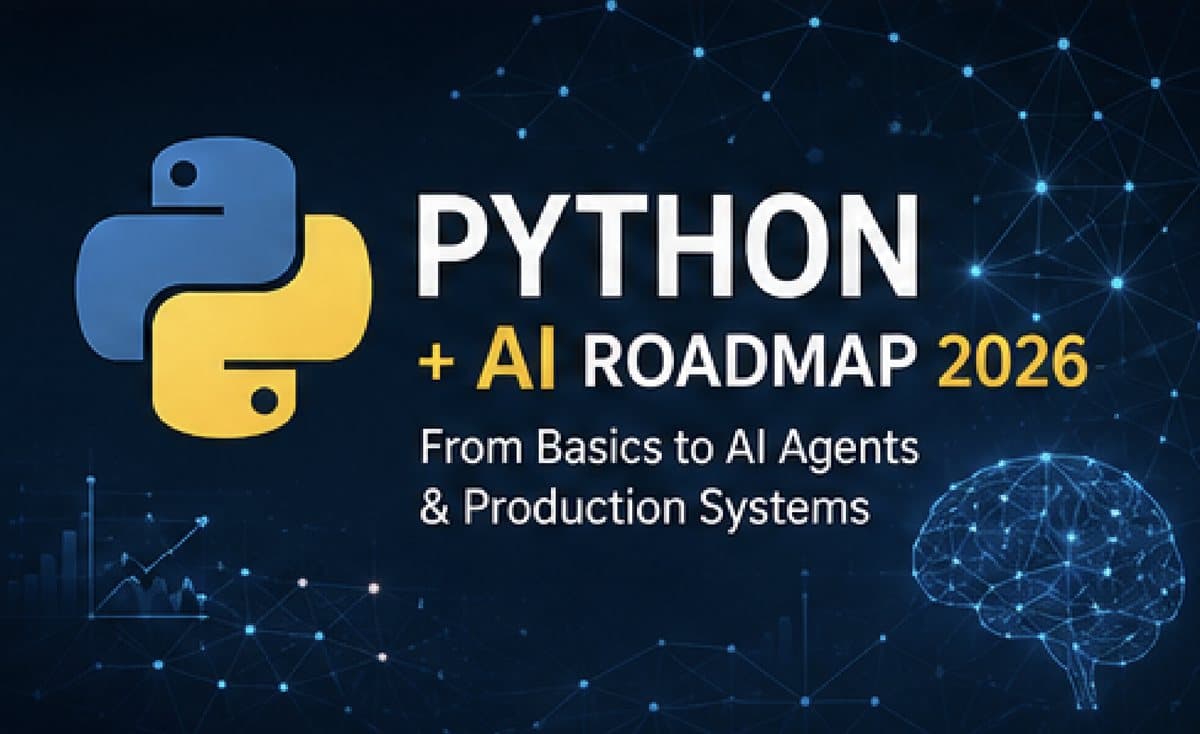
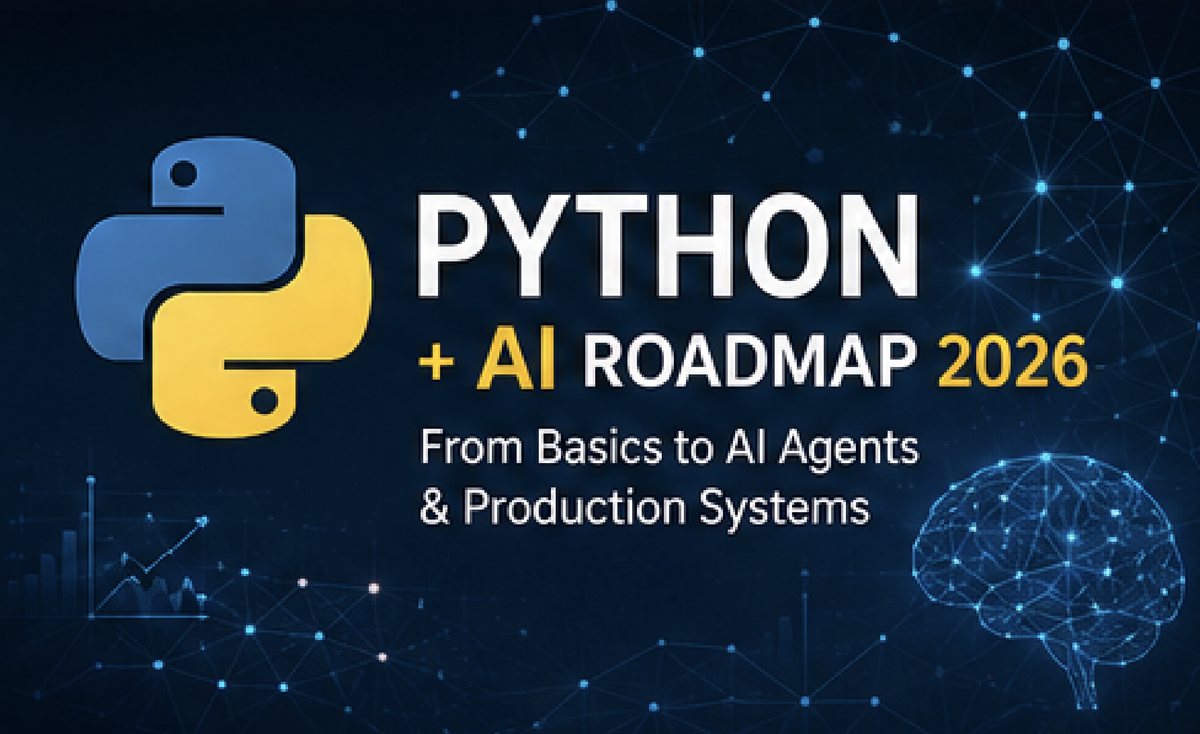
Python Roadmap 2026: From Basics to AI Agents and Production Systems

In short
Python is three careers in one language: backend engineering, data and ML, and generative AI. This is the full 16-level path, the three branches you can take at Level 10, the project ladder and the 2026 stack.
Python is three careers in one language: backend engineering, data and ML, and generative AI. This is the full 16-level path, the three branches you can take at Level 10, the project ladder and the 2026 stack.
Python's problem is not that it is hard. It is that it is too broad. The same language runs web backends, data pipelines, machine learning models, automation scripts and AI agents — so "learn Python" is not a plan, and most learners stall somewhere between "I finished a tutorial series" and "I can build something a company would pay for".
The fix is sequencing. Build strong Python engineering first, then branch deliberately into backend, data/ML or AI application development. That is what this roadmap does: sixteen levels, then three named career directions.
The roadmap at a glance
| Levels | Focus | What you can build after it |
|---|---|---|
| 1–3 | Fundamentals, Python basics, functions, object model | Real scripts and small tools |
| 4–5 | Advanced functions, OOP, modern Python, data model | Well-designed Python programs |
| 6–7 | Collections, generators, decorators, packaging, memory | Idiomatic, packaged Python |
| 8–9 | Concurrency, SQL, PostgreSQL, SQLAlchemy, FastAPI | Production-shaped REST APIs |
| 10 | Security, testing, Docker, Redis, Celery, CI/CD | Deployable backend systems |
| 11–12 | NumPy, Pandas, statistics, ML, deep learning | Trained, evaluated models |
| 13–14 | LLM APIs, embeddings, vector DBs, RAG, agents | AI applications |
| 15–16 | AI security, evaluation, LLMOps, architecture | Systems that survive production |
Levels 1–3 — Fundamentals, Python and the object model
Programming fundamentals first: concepts, algorithms, flowcharts, variables, data types, operators, conditions, loops, functions, input/output, debugging, basic data structures, and time and space complexity. Practise on a calculator, number guessing game, ATM, billing system, student marks system and banking application.
Python basics: the interpreter, CPython, the REPL, Python files, VS Code, virtual environments and pip; variables, dynamic typing, indentation, statements and expressions. Data types: int, float, complex, bool, str, None, list, tuple, set, dict, mutable vs immutable, hashable vs unhashable, indexing and slicing.
Functions and the object model: parameters, return values, default and keyword arguments, *args, **kwargs, scope, recursion, docstrings and type hints — then the part most self-taught developers skip: everything is an object, id(), type(), isinstance(), identity vs equality, references, mutability, namespaces and attribute lookup.
Understanding mutability and references early prevents an entire category of bugs that otherwise haunts you for years.
Levels 4–5 — Advanced functions, OOP and modern Python
Advanced functions: first-class and higher-order functions, nested functions, closures, lambda, function factories, map/filter/reduce, functools, partial and lru_cache.
OOP: classes and objects, constructors, instance vs class attributes, methods, classmethod, staticmethod, encapsulation, inheritance, polymorphism, abstraction, multiple inheritance, MRO and C3 linearisation, super(), ABCs, protocols, duck typing and composition.
Modern Python and the data model: dataclasses, Enum, NamedTuple, TypedDict, Protocol, type aliases, generics, and the special methods — __init__, __str__, __repr__, __eq__, __hash__, __len__, __iter__, __next__, __getitem__, __enter__, __exit__.
Dataclasses and type hints are what make a Python codebase reviewable by other people. Adopt them before you have a large codebase without them.
Levels 6–7 — Collections, generators, packaging and memory
Collections: list, dict, set, tuple, plus Counter, defaultdict, deque and namedtuple. Iterators: iterable vs iterator, the iterator protocol, iter(), next(). Generators: yield, generator expressions, lazy evaluation, generator pipelines and yield from. Decorators: function wrappers, decorator arguments, stacking, functools.wraps and class decorators. Context managers: with, __enter__/__exit__, contextlib and custom managers.
Exceptions and packaging: try/except/else/finally, raise, custom exceptions, the exception hierarchy, exception chaining, logging; modules, packages, __init__.py, absolute and relative imports, __name__/__main__, venv, pip, pyproject.toml, requirements and dependency management.
Memory: the Python memory model, reference counting, garbage collection, circular references, the gc module, object lifecycle, del, interning, small-integer caching, memory leaks and profiling.
Levels 8–9 — Concurrency, SQL, FastAPI
Concurrency: threading, ThreadPoolExecutor, locks, race conditions, multiprocessing, process pools, IPC concepts, asyncio, async/await, the event loop, tasks, futures, async generators — and the GIL, which you should be able to explain in one clear sentence.
SQL: the verbs, JOIN, GROUP BY, HAVING, subqueries, CTEs, window functions, views, indexes, transactions, ACID, isolation, locking and query optimisation.
Data access: PostgreSQL, DB-API, connections, cursors, parameterised queries, transactions and connection pooling; then SQLAlchemy — models, sessions, relationships, queries, transactions and Alembic migrations.
FastAPI: routing, request handling, response models, Pydantic, validation, dependency injection, middleware, background tasks, OpenAPI and Swagger — plus REST fundamentals: HTTP, the verbs, headers, JSON, status codes, pagination, filtering, sorting and versioning.
FastAPI plus Pydantic plus SQLAlchemy is the current default Python backend stack, and it is also the stack most AI applications are served from. Our Python Full Stack course covers this level end to end.
Level 10 — Security, testing and production
Security: password hashing, OAuth 2.0, JWT, access and refresh tokens, roles, permissions, RBAC, CORS, CSRF, rate limiting, input validation and secrets management.
Testing: pytest, fixtures, assertions, parameterised tests, mocking, the FastAPI TestClient, integration tests, Testcontainers and Playwright.
Production: Docker (Dockerfile, images, containers, volumes, networks, Compose, environment variables, health checks); Redis (caching, TTL, distributed locks, sessions); Celery (background workers, queues, retries, idempotency); cloud deployment and CI/CD.
This is the level that decides whether you are hireable. A model in a notebook is a hobby; a tested, containerised, deployed API is a job.
Levels 11–12 — Data, machine learning and deep learning
NumPy: arrays, shape, dimensions, indexing, slicing, broadcasting, vectorisation, matrix operations and linear algebra basics.
Pandas: Series and DataFrame, CSV/Excel/JSON, filtering, sorting, grouping, merging, joining, missing data, aggregation, data cleaning and feature preparation.
Visualisation: Matplotlib, Seaborn, Plotly — charts, distributions, correlation and heatmaps.
Statistics: mean, median, mode, variance, standard deviation, percentiles, probability, conditional probability, Bayes' theorem, distributions, correlation, covariance, sampling, hypothesis testing and confidence intervals.
Machine learning: scikit-learn — linear and logistic regression, decision trees, random forests, gradient boosting, SVM, KNN, K-Means, PCA, clustering, cross-validation, overfitting and underfitting, precision, recall, F1, ROC-AUC, the confusion matrix, feature engineering and hyperparameter tuning.
The workflow to internalise: problem → data → cleaning → EDA → features → split → train → evaluate → tune → save → deploy → monitor. Most tutorials stop at "train". The last three steps are the job.
Deep learning: neural networks, perceptrons, activation and loss functions, backpropagation, gradient descent; PyTorch — tensors, models, datasets, DataLoaders, training loops, GPU usage, model saving and loading.
Transformers: tokens and tokenisation, embeddings, attention and self-attention, positional information, encoder, decoder and the transformer architecture. This is what makes the next level make sense rather than feel like magic.
Our Data Science and Machine Learning tracks live at these two levels.
Levels 13–14 — Generative AI, RAG and agents
LLM APIs: prompting, system instructions, user messages, tokens, context windows, structured output, streaming, function/tool calling and model selection.
Prompt engineering: clear instructions, context, constraints, examples, structured outputs and prompt templates — see our advanced prompt engineering guide.
Embeddings and vector databases: text-to-vector representation, similarity, cosine similarity, semantic search; PostgreSQL + pgvector, Qdrant, Pinecone, Weaviate, Elasticsearch/OpenSearch.
RAG: document ingestion, parsing, chunking, embeddings, vector storage, retrieval, reranking, context construction, grounded generation, citations and evaluation. Start with what RAG actually is.
Tool calling: database tools, search, email, CRM, inventory, calendar and internal APIs.
Agents: agent architecture, tool use, planning, memory, state, multi-step workflows, human-in-the-loop and orchestration. Our complete guide to AI agents covers the patterns in depth.
Frameworks: LangChain, LangGraph, LlamaIndex, model-provider SDKs and Semantic Kernel concepts — learned after you understand the underlying API, retrieval, tool and workflow concepts. Framework-first learners tend to be helpless the moment the abstraction leaks.
Levels 15–16 — AI security, evaluation, LLMOps and architecture
Security: prompt injection, jailbreaking concepts, data leakage, excessive permissions, tool authorisation, input and output validation, rate limiting, audit logging, human approval and secret management.
Evaluation: accuracy, relevance, groundedness, hallucination rate, retrieval quality, tool-selection accuracy, latency, token usage, cost and regression testing.
MLOps / LLMOps: model and data versioning, experiment tracking, model registry, deployment, monitoring, prompt versioning, tracing, guardrails and cost monitoring.
Architecture: SOLID, DRY, KISS, separation of concerns, layered and Clean Architecture, hexagonal architecture, repository and service patterns, dependency injection, modular monolith, microservices, event-driven architecture, messaging, caching, queues, scalability, fault tolerance, idempotency and AI system design.
Three Python career directions
At around Level 10, the path forks. Pick one deliberately:
1. Python Full Stack + AI — Python → advanced Python → SQL → PostgreSQL → FastAPI → SQLAlchemy → REST → security → React → Docker → Redis → cloud → LLM APIs → RAG → agents.
2. AI/ML Engineer — Python → NumPy → Pandas → statistics → machine learning → PyTorch → transformers → LLMs → RAG → agents → MLOps/LLMOps.
3. AI-focused software engineer — strong Python backend engineering combined with data, LLM APIs, RAG, tools, agents, security, evaluation and production deployment. In practice this is the most in-demand of the three, because it is the rarest combination.
The project ladder
- Calculator / banking console application
- Student management system
- Advanced OOP / plugin-based application
- Inventory system with PostgreSQL
- FastAPI employee REST API
- SQLAlchemy e-commerce backend
- JWT authentication system
- React + FastAPI full-stack application
- Redis-enabled API
- Background job processing system
- Containerised FastAPI application
- Sales analytics project
- Customer churn ML model
- PyTorch deep learning project
- AI chat application
- RAG document assistant
- AI business assistant with tool calling
- AI agent workflow
- Multi-agent workflow
- Enterprise AI platform
Projects 5, 13 and 16 are the three that most often carry an interview on their own.
The recommended 2026 stack
Python + FastAPI + Pydantic + SQLAlchemy + PostgreSQL + Redis + Celery + Docker + React/TypeScript + cloud + NumPy + Pandas + scikit-learn + PyTorch + LLM APIs + pgvector + RAG + LangGraph + AI agents + MLOps/LLMOps.
Where this leads
Python Developer, Backend Developer, Python Full Stack Developer, FastAPI Developer, Data Analyst, Data Scientist, Machine Learning Engineer, AI Engineer, Generative AI Developer, LLM Application Developer, AI Solutions Developer and MLOps/LLMOps Engineer.
Pune demand is strongest at the two ends: FastAPI backend work in product companies, and AI/LLM application work across both product firms and services practices building client copilots. Cross-check role expectations with our Pune IT career roadmap.
Frequently asked questions
How long does this roadmap take?
Levels 1–10 take roughly 6–8 months of consistent study and make you employable as a Python backend developer. The data and ML levels add 3–4 months; the AI levels another 2–3. Choosing one branch at Level 10 rather than attempting all three is what keeps the timeline realistic.
Should I learn Django or FastAPI?
FastAPI for new API work, async workloads and AI applications — which is where this roadmap points. Django remains excellent for content-heavy, admin-driven applications, and plenty of Pune jobs still ask for it.
Do I need machine learning to work in AI?
No, and this surprises people. Most generative AI application jobs need Python, APIs, retrieval, tool calling, evaluation and production engineering — not model training. ML is required for the AI/ML Engineer branch specifically.
Is Python better than Java for backend work?
Different markets. Java dominates Pune's enterprise and services backend hiring by volume; Python dominates data, ML and AI application work and is strong in product companies. See the Java roadmap if enterprise backend is your target.
Can a non-CS graduate follow this path?
Yes — Python is the most forgiving entry point of the three roadmaps, and the data/analytics branch in particular takes non-CS graduates regularly. Our career switch guide for non-CS candidates covers the wider strategy.
Do I need a GPU for the deep learning levels?
Not to learn. Free hosted notebooks cover the training exercises at this scale. Buy hardware only when a project genuinely demands it.
Bottom line
Python's breadth is an advantage only if you sequence it. Core Python and the object model, then packaging and concurrency, then FastAPI and databases, then production engineering — and only then the branch you have chosen, whether that is data and ML or generative AI.
Python is the foundation; AI is a specialisation built on top of strong software engineering. Do not become dependent on AI-generated code — understand the language, runtime, architecture, security, data, testing and performance of what you build.
Want this as a structured programme? Archer Infotech has trained 10,000+ students in Pune since 2009, with 5,000+ placed. Start with Python training in Pune, go end-to-end with Python Full Stack, or take the data branch with Data Science training. Talk to our team about which branch fits your background.
Pune IT careers — monthly briefing
One email a month with the most actionable Pune IT hiring + salary updates. Free.
One email per month. No spam. Unsubscribe anytime.