
Data Analytics vs Data Engineering vs Data Science vs Machine Learning: Differences, Technologies and the Best Learning Sequence

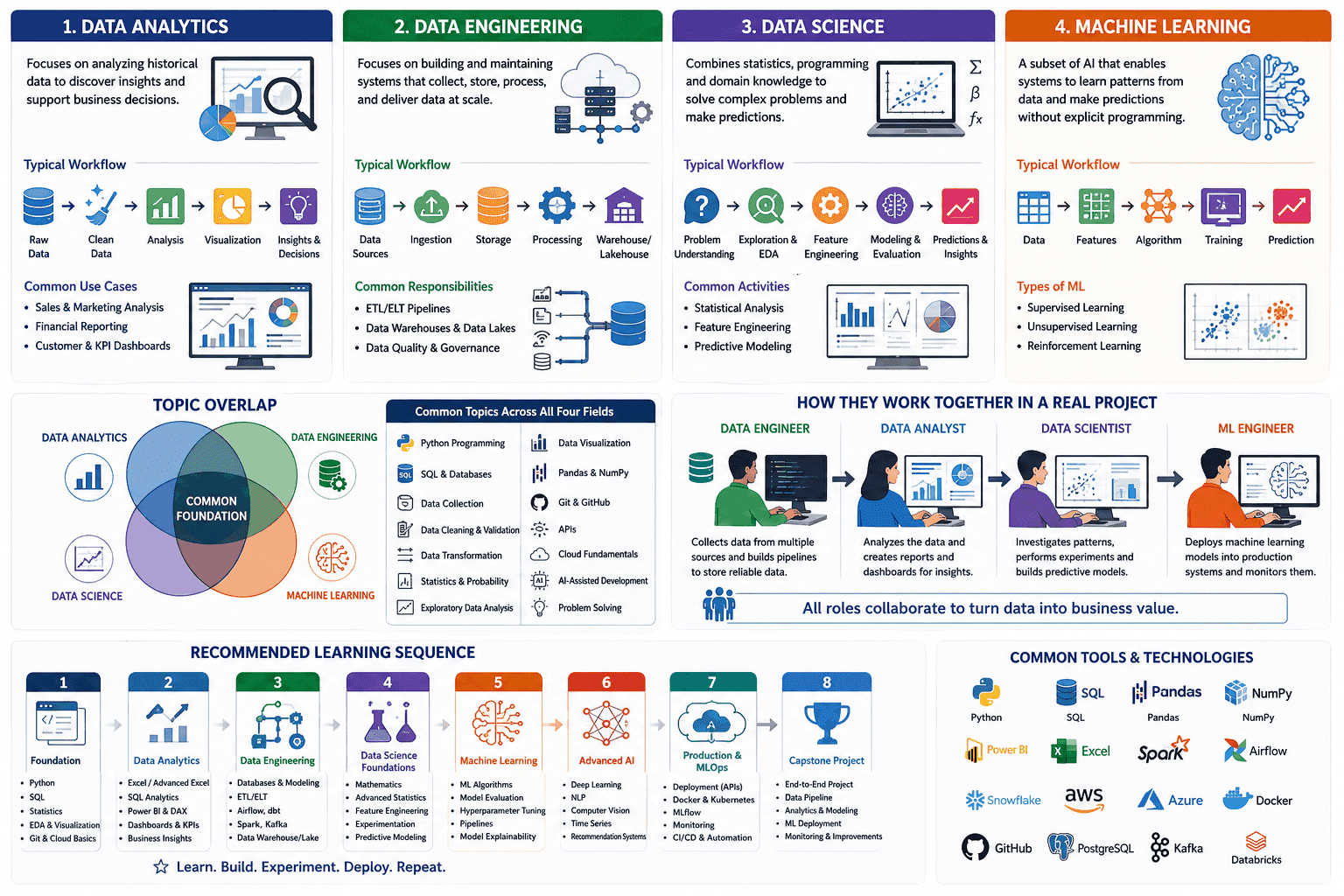
In short
Four fields, one shared foundation. This guide breaks down what each discipline actually does, the technologies covered in each, where they overlap, what they pay in Pune, and the eight-stage sequence to learn all four without relearning Python, SQL and Pandas four times.
Four fields, one shared foundation. This guide breaks down what each discipline actually does, the technologies covered in each, where they overlap, what they pay in Pune, and the eight-stage sequence to learn all four without relearning Python, SQL and Pandas four times.
Data Analytics, Data Engineering, Data Science and Machine Learning are four of the most searched-for career tracks in Indian IT — and four of the most confused. They share programming languages, databases, processing tools and statistical concepts, which is exactly why beginners cannot tell them apart.
Almost every student who walks into our Pune classroom arrives with the same set of questions:
- What exactly is Data Analytics?
- What does a Data Engineer actually do all day?
- How is Data Science different from Data Analytics?
- Is Machine Learning part of Data Science, or a separate field?
- Which topics are common across all four?
- If I want to learn all four, where do I start?
- Should I take four separate courses, or one continuous learning path?
That last question is the expensive one. Get it wrong and you pay four times to learn Python, SQL, Pandas, statistics and data cleaning — because every one of those four courses teaches them again from scratch.
This guide answers all of it: what each field is, the technologies covered in each, where they overlap, where they separate, and the learning sequence that gets you through all four without repeating yourself.
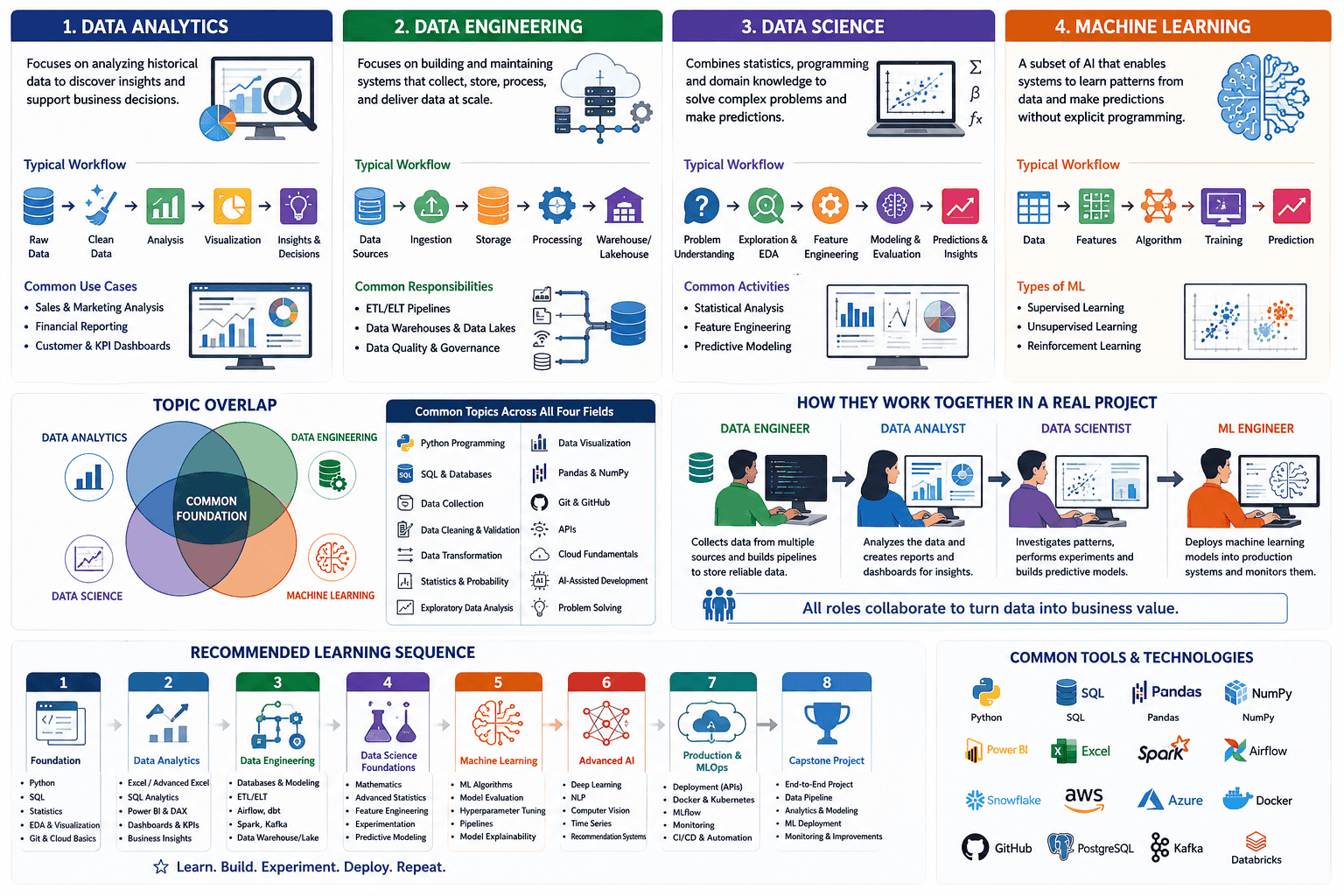
The one-line version
If you remember nothing else from this guide, remember this:
Data Engineering builds the data foundation. Data Analytics explains the data. Data Science investigates and solves complex problems with it. Machine Learning learns from it to make predictions.
Four layers of the same ecosystem — not four unrelated subjects.
What is Data Analytics?
Data Analytics is the process of collecting, cleaning, transforming, analysing and visualising data to discover useful information and support business decisions.
A Data Analyst works mostly with historical and current data, and turns it into insights that business stakeholders can actually act on. The questions a Data Analyst answers are backward- and present-looking:
- What happened?
- Why did it happen?
- Which products are performing best?
- Why are sales decreasing?
- Which region generates the highest revenue?
- Which marketing campaign performs better?
- Why are customers leaving?
- How is the organisation performing against its targets?
Typical workflow:
Raw Data → Data Cleaning → Data Analysis → Visualisation → Business Insights → Decision Making
Technologies Covered in Data Analytics
| Category | Technologies |
|---|---|
| Spreadsheets | Microsoft Excel, Advanced Excel, Power Query, Pivot Tables |
| Querying | SQL, joins, subqueries, CTEs, window functions |
| Programming | Python, Pandas, NumPy |
| Statistics | Descriptive statistics, distributions, correlation, hypothesis basics |
| Visualisation | Matplotlib, Seaborn, Plotly |
| BI and dashboards | Power BI, DAX, data modelling for BI, KPI design |
| Version control | Git, GitHub |
| Modern workflow | AI-assisted analysis, prompt-based query writing (always validated) |
Typical Data Analytics use cases
Sales analysis, marketing analytics, financial reporting, customer analysis, HR analytics, operational analytics, inventory analysis, business performance tracking, revenue and profitability analysis.
The objective of Data Analytics: understand data and convert it into meaningful business insights.
This is the stack covered in our Data Analytics course in Pune — a 3-month beginner-level track built around Excel, SQL, Python and Power BI.
What is Data Engineering?
Data Engineering focuses on designing, building and maintaining the systems that collect, store, process, transform and deliver data.
Analysts and scientists work with data. Data Engineers build the infrastructure that makes that data exist, arrive on time and be trustworthy when it gets there.
A single organisation generates data from websites, mobile apps, CRM systems, ERP systems, IoT devices, payment systems, APIs, databases, log files and cloud applications. The Data Engineer builds the pipelines that move all of it into platforms where analysts, scientists, applications and AI systems can consume it.
Typical workflow:
Data Sources → Ingestion → Storage → Transformation → Processing → Data Warehouse / Lakehouse → Data Consumers
Technologies Covered in Data Engineering
| Category | Technologies |
|---|---|
| Programming | Python, SQL, Linux/shell |
| Databases | PostgreSQL, MySQL, MongoDB, OLTP and OLAP design |
| Batch processing | Apache Spark, PySpark |
| Streaming | Apache Kafka, stream processing, Change Data Capture |
| Orchestration | Apache Airflow, dbt |
| Warehouse and lakehouse | Snowflake, Databricks, Delta Lake, Apache Iceberg, Google BigQuery |
| Cloud data services | Azure Data Factory, AWS Glue, cloud storage and compute |
| Engineering practice | Docker, Git, CI/CD, data quality, observability, governance, DataOps |
Typical Data Engineering responsibilities
Building ETL/ELT pipelines, batch and streaming pipelines, designing databases and warehouses, creating lakehouse architectures, processing large datasets, managing data quality, implementing Change Data Capture, orchestrating pipelines, tuning pipeline performance, managing data lineage, enforcing data governance.
The objective of Data Engineering: make trustworthy data available at the right place, in the right format, at the right time.
Our Data Engineering course in Pune is a 4-month advanced track covering Spark, Kafka, Airflow, warehousing and cloud data platforms.
What is Data Science?
Data Science combines programming, mathematics, statistics, domain knowledge and Machine Learning to identify patterns in data and solve complex problems.
Where Analytics largely explains what already happened, Data Science goes further and tries to work out what happens next — and why.
Typical questions:
- Which customers are likely to leave?
- What will next month's sales be?
- Is this transaction fraudulent?
- Which customers are likely to buy a particular product?
- What is the expected price of this property?
- Which patients may be at higher risk?
- How should customers be segmented?
- Which factors have the strongest impact on an outcome?
Typical workflow:
Problem → Data → Exploration → Feature Engineering → Modelling → Evaluation → Prediction → Decision
Technologies Covered in Data Science
| Category | Technologies |
|---|---|
| Programming | Python, SQL, Jupyter Notebook |
| Data handling | NumPy, Pandas |
| Mathematics | Linear algebra, calculus, optimisation |
| Statistics | Probability, distributions, sampling, hypothesis testing, statistical inference |
| Visualisation | Matplotlib, Seaborn, Plotly |
| Modelling | Scikit-Learn, XGBoost, statsmodels |
| Deep learning | TensorFlow, PyTorch |
| Experiment tracking | MLflow, experiment design, A/B testing |
| Platform | Cloud platforms, Git, APIs, Docker |
Typical Data Science responsibilities
Data cleaning, exploratory data analysis, statistical analysis, hypothesis testing, feature engineering and selection, predictive modelling, time-series forecasting, experimentation, model interpretation and evaluation, business problem solving.
The objective of Data Science: use data, statistics and predictive modelling to solve complex problems and support intelligent decision-making.
Our Data Science course in Pune runs 5 months and covers the mathematics, statistics, EDA and modelling layers together.
What is Machine Learning?
Machine Learning is a branch of Artificial Intelligence that enables computers to learn patterns from data and make predictions or decisions without every rule being manually programmed.
Instead of writing hundreds of rules to catch fraudulent transactions, you give an algorithm historical transactions and let it learn the fraud patterns itself.
Typical workflow:
Data → Features → Algorithm → Training → Model → Evaluation → Prediction
The major types of Machine Learning
Supervised learning — the algorithm learns from labelled data. Covers regression and classification. Used for house price prediction, customer churn prediction, credit risk scoring, fraud detection and sales forecasting.
Unsupervised learning — the algorithm works with unlabelled data and discovers structure on its own. Covers clustering, dimensionality reduction and anomaly detection. Used for customer segmentation, fraud pattern discovery, grouping similar products and detecting unusual transactions.
Semi-supervised learning — a combination of labelled and unlabelled data, useful when labelling is expensive.
Reinforcement learning — an agent learns by interacting with an environment and receiving rewards or penalties.
Technologies Covered in Machine Learning
| Category | Technologies |
|---|---|
| Programming | Python, NumPy, Pandas, Jupyter |
| Core ML library | Scikit-Learn |
| Gradient boosting | XGBoost, LightGBM, CatBoost |
| Deep learning | TensorFlow, Keras, PyTorch |
| Feature work | Feature engineering, encoding, scaling, selection, imbalanced-data handling |
| Model quality | Cross-validation, hyperparameter optimisation, error analysis |
| Explainability | SHAP, LIME, model interpretation |
| Production | MLflow, FastAPI, Docker, model serving, monitoring, MLOps, CI/CD |
Common Machine Learning algorithms
Linear Regression, Logistic Regression, K-Nearest Neighbors, Naive Bayes, Decision Trees, Support Vector Machines, Random Forest, AdaBoost, Gradient Boosting, XGBoost, LightGBM, CatBoost, K-Means, Hierarchical Clustering, DBSCAN, Gaussian Mixture Models, Isolation Forest.
The objective of Machine Learning: learn patterns from data and use them to make predictions or decisions on new data.
Our Machine Learning course in Pune is a 4-month intermediate track covering supervised and unsupervised algorithms, feature engineering, model evaluation and real projects.
Data Analytics vs Data Engineering vs Data Science vs Machine Learning
Here is the side-by-side view:
Here is the side-by-side view:
| Data Analytics | Data Engineering | Data Science | Machine Learning | |
|---|---|---|---|---|
| Core question | What happened and why? | How does data get here reliably? | What will happen, and what drives it? | How do we predict it at scale? |
| Primary output | Dashboards, reports, insights | Pipelines, warehouses, reliable datasets | Experiments, models, findings | Production models and predictions |
| Signature tools | Excel, SQL, Power BI | Spark, Kafka, Airflow, Snowflake | Python, statistics, Scikit-Learn | Scikit-Learn, XGBoost, PyTorch |
| Maths intensity | Low to moderate | Low | High | High |
| Engineering intensity | Low | High | Moderate | High |
| Typical entry level | Beginner-friendly | Needs programming maturity | Needs maths and statistics | Needs ML plus engineering |
| Time horizon | Past and present | Continuous / real-time | Future and causal | Future, automated |
In words, if you prefer them:
Data Analytics — asks what happened and why. Ships dashboards, reports and insights. Runs on Excel, SQL and Power BI. Low maths, low engineering, beginner-friendly. Looks at the past and present.
Data Engineering — asks how does data get here reliably. Ships pipelines, warehouses and trustworthy datasets. Runs on Spark, Kafka, Airflow and Snowflake. Low maths, heavy engineering. Needs programming maturity. Works continuously, often in real time.
Data Science — asks what will happen, and what drives it. Ships experiments, models and findings. Runs on Python, statistics and Scikit-Learn. High maths, moderate engineering. Needs statistics. Looks forward, and at cause.
Machine Learning — asks how do we predict it at scale. Ships production models and predictions. Runs on Scikit-Learn, XGBoost and PyTorch. High maths, heavy engineering. Needs ML plus engineering. Looks forward, automatically.
And as a flow, which is how these actually sit inside a company:
Data Engineering — Sources → Ingestion → Storage → Processing → Reliable Data ↓ Data Analytics — Reliable Data → Analysis → Dashboards → Insights ↓ Data Science — Data → Statistics → Experimentation → Predictive Problems ↓ Machine Learning — Features → Algorithms → Training → Prediction
The boundaries are real, but they are not rigid. In actual projects, professionals routinely borrow from all four.
Topic overlap: how much do these fields actually share?
This is the table that explains why learning them separately wastes so much time.
| Topic | Data Analytics | Data Science | Machine Learning | Data Engineering |
|---|---|---|---|---|
| Python Fundamentals | ✅ | ✅ | ✅ | ✅ |
| SQL | ✅ | ✅ | ✅ | ✅ |
| Databases | ✅ | ✅ | ◐ | ✅ |
| Data Types & Formats | ✅ | ✅ | ✅ | ✅ |
| Data Collection | ✅ | ✅ | ✅ | ✅ |
| Data Cleaning | ✅ | ✅ | ✅ | ✅ |
| Missing Value Handling | ✅ | ✅ | ✅ | ✅ |
| Duplicate Handling | ✅ | ✅ | ✅ | ✅ |
| Data Transformation | ✅ | ✅ | ✅ | ✅ |
| Data Quality | ✅ | ✅ | ✅ | ✅ |
| NumPy | ✅ | ✅ | ✅ | ◐ |
| Pandas | ✅ | ✅ | ✅ | ✅ |
| Statistics | ✅ | ✅ | ✅ | ◐ |
| Probability | ◐ | ✅ | ✅ | ◐ |
| Exploratory Data Analysis | ✅ | ✅ | ✅ | ◐ |
| Data Visualisation | ✅ | ✅ | ✅ | ◐ |
| Matplotlib / Seaborn | ✅ | ✅ | ✅ | ◐ |
| Feature Engineering | ◐ | ✅ | ✅ | ◐ |
| Feature Scaling | ◐ | ✅ | ✅ | ❌ |
| Feature Encoding | ◐ | ✅ | ✅ | ◐ |
| Feature Selection | ❌ | ✅ | ✅ | ❌ |
| ML Algorithms | ◐ | ✅ | ✅ | ❌ |
| Model Evaluation | ❌ | ✅ | ✅ | ❌ |
| Deep Learning | ❌ | ✅ | ◐ | ❌ |
| Time Series | ✅ | ✅ | ✅ | ◐ |
| Data Modelling | ◐ | ◐ | ❌ | ✅ |
| ETL / ELT | ◐ | ◐ | ◐ | ✅ |
| Data Pipelines | ◐ | ◐ | ◐ | ✅ |
| Data Warehousing | ✅ | ◐ | ❌ | ✅ |
| Data Lakes | ◐ | ◐ | ◐ | ✅ |
| Spark / PySpark | ◐ | ◐ | ◐ | ✅ |
| Kafka / Streaming | ❌ | ◐ | ❌ | ✅ |
| Cloud | ◐ | ✅ | ✅ | ✅ |
| Git / GitHub | ✅ | ✅ | ✅ | ✅ |
| APIs | ◐ | ✅ | ✅ | ✅ |
| Docker | ◐ | ✅ | ✅ | ✅ |
| Deployment | ❌ | ✅ | ✅ | ✅ |
| Data Governance | ◐ | ◐ | ◐ | ✅ |
| Data Security | ◐ | ◐ | ◐ | ✅ |
| AI-Assisted Development | ✅ | ✅ | ✅ | ✅ |
Legend: ✅ major/core topic · ◐ useful or supporting topic · ❌ usually not a core topic
Count the rows that are ✅ across all four columns. That is your common foundation — and it is large.
The common foundation: learn these once
If you plan to learn all four fields, these subjects should be learned once, properly, before you specialise.
1. Python — fundamentals, variables, data types, operators, conditions, loops, functions, collections, OOP, exception handling, file handling, modules and packages.
2. SQL — SELECT, WHERE, GROUP BY, HAVING, joins, subqueries, CTEs, window functions, views, aggregate functions.
3. Databases — RDBMS concepts, tables, rows, columns, primary and foreign keys, relationships, schemas, normalisation, indexing. Data Engineering goes far deeper here later.
4. Data types and formats — structured, semi-structured and unstructured data; CSV, JSON, Excel, database tables, Parquet.
5. Data collection — databases, CSV and Excel files, APIs, applications, websites, cloud storage, event streams.
6. Data cleaning — missing values, duplicates, invalid values, wrong data types, formatting issues, inconsistent categories, outliers.
7. Data transformation — filtering, sorting, grouping, aggregation, joining, reshaping, type conversion, standardisation.
8. Data quality — accuracy, completeness, consistency, validity, uniqueness, timeliness.
9. Pandas — Series, DataFrames, filtering, grouping, aggregation, merge, join, missing-value handling, transformation.
10. NumPy — arrays, mathematical operations, statistics, vectorisation, matrix operations.
11. Statistics — mean, median, mode, variance, standard deviation, percentiles, correlation, distributions.
12. Exploratory Data Analysis — dataset understanding, univariate, bivariate and multivariate analysis, correlation, distribution and outlier analysis.
13. Data visualisation — Matplotlib, Seaborn, Plotly; plus Power BI and Excel dashboards on the Analytics side.
14. Git and GitHub — repositories, clone, commit, push, pull, branching, collaboration, project documentation.
15. Cloud fundamentals — compute, storage, databases, networking, core cloud services.
16. AI-assisted development — using AI tools to write Python and SQL, debug, explore data, document, generate tests, explain queries and suggest visualisations. Every output still needs validating; that verification skill is now part of the job.
Where the four fields separate
After the common foundation, each track develops its own specialisation.
Data Analytics specialisation
Data → Clean → Analyse → Visualise → Explain → Business Decision
Excel, Advanced Excel, Power Query, SQL analytics, statistics, EDA, data visualisation, Power BI, data modelling for BI, DAX, dashboards, KPIs, business analytics, sales/marketing/financial/HR analytics, data storytelling, executive reporting.
Data Engineering specialisation
Source → Ingest → Store → Transform → Process → Serve
Advanced SQL, database design, data modelling, OLTP, OLAP, data warehousing, ETL, ELT, Change Data Capture, data pipelines, Airflow, dbt, Spark, PySpark, Kafka, stream processing, data lakes, lakehouse architecture, Delta Lake, Databricks, Snowflake, cloud data engineering, data quality, observability, governance, security, DataOps.
Data Science specialisation
Data → Explore → Engineer Features → Model → Experiment → Solve Problems
Mathematics, linear algebra, calculus, probability, advanced statistics, statistical testing, advanced EDA, feature engineering, experimentation, predictive modelling, machine learning, time-series forecasting, model interpretation and evaluation, deep learning, NLP, computer vision.
Machine Learning specialisation
Data → Features → Algorithm → Training → Evaluation → Optimisation → Prediction
Preprocessing, feature engineering, selection and scaling, regression, classification, Linear and Logistic Regression, KNN, Naive Bayes, Decision Trees, SVM, Random Forest, bagging, boosting, AdaBoost, Gradient Boosting, XGBoost, LightGBM, CatBoost, clustering, K-Means, hierarchical clustering, DBSCAN, PCA, anomaly detection, imbalanced learning, cross-validation, hyperparameter optimisation, ML pipelines, model explainability, SHAP, LIME, error analysis.
What should you learn first?
Taking four independent courses back-to-back is the inefficient route, because you will sit through Python, SQL, Pandas, data cleaning, statistics, visualisation, EDA, Git and databases four separate times.
A single unified journey is faster and cheaper. Here is the sequence we recommend.
Stage 1 — Build the common foundation
- Programming: Python fundamentals, functions, collections, OOP, file handling
- Databases: SQL, database fundamentals, joins, CTEs, window functions
- Data processing: NumPy, Pandas, data cleaning, data transformation
- Basic statistics: mean, median, standard deviation, probability basics, correlation
- Data exploration: EDA, Matplotlib, Seaborn
- Engineering basics: Git, GitHub, Linux basics, cloud fundamentals
This foundation supports all four career paths. Our Python course in Pune covers the programming half of this stage if you are starting from zero.
Stage 2 — Learn Data Analytics
Excel → Advanced Excel → Power Query → SQL Analytics → Statistics → EDA → Power BI → DAX → Dashboards → KPIs → Business Analytics → Data Storytelling
Why Analytics first? Because it teaches you to understand datasets, identify business problems, analyse patterns, ask good questions, communicate findings, and grasp what information a business actually needs. Those habits stay valuable through Data Science and Machine Learning — and they are exactly what most self-taught ML learners are missing.
Stage 3 — Learn Data Engineering
Advanced SQL → Databases → Data Modelling → ETL/ELT → Data Warehousing → Airflow → dbt → Spark → PySpark → Kafka → CDC → Data Lakes → Lakehouse → Databricks → Snowflake → Cloud → Data Quality → Governance
Here you learn where data comes from, how large datasets are processed and stored, how production pipelines work, and how data quality is maintained.
Stage 4 — Learn Data Science foundations
- Mathematics: linear algebra, calculus, optimisation
- Statistics: probability, distributions, sampling, hypothesis testing, correlation, statistical inference
- Techniques: advanced EDA, feature engineering, experimentation, problem formulation, predictive modelling
At this stage Machine Learning should be introduced conceptually — do not teach every algorithm twice.
Stage 5 — Specialise deeply in Machine Learning
Preprocessing → Feature Engineering → Regression → Classification → Decision Trees → SVM → Random Forest → Ensemble Learning → Boosting → XGBoost / LightGBM / CatBoost → Clustering → Dimensionality Reduction → Anomaly Detection → Imbalanced Learning → Cross-Validation → Hyperparameter Optimisation → ML Pipelines → Explainable ML
This stage must include heavy project work and experimentation. Reading about algorithms does not build the intuition; failing on real datasets does.
Stage 6 — Advanced Data Science and AI
Deep Learning, neural networks, CNN, RNN, LSTM, Transformers, Natural Language Processing, Computer Vision, recommendation systems.
Stage 7 — Production engineering
A model that never leaves a notebook has no business value. Learn FastAPI, REST APIs, Docker, cloud deployment, model serving, MLflow, experiment tracking, model registry, model monitoring, data drift, MLOps and CI/CD. This is where your Stage 3 Data Engineering knowledge pays off twice.
Stage 8 — Build an integrated capstone project
One project that spans everything:
- Data sources — database, API, files, event streams
- Data engineering — ingestion pipeline, ETL/ELT, data lake, warehouse/lakehouse, data quality checks
- Data analytics — SQL analysis, KPI analysis, dashboards, business insights
- Data science — EDA, statistical analysis, feature engineering, experimentation
- Machine learning — baseline model, multiple algorithms, model comparison, hyperparameter optimisation, explainability
- Deployment — prediction API, Docker, cloud deployment
- Monitoring — pipeline monitoring, data quality checks, model monitoring, logging
One such project demonstrates the entire modern data lifecycle — and interviews far better than four course certificates.
The complete recommended learning path
Common Foundation → Data Analytics → Data Engineering → Data Science Foundations → Machine Learning → Deep Learning and Advanced Data Science → Production Engineering and MLOps → Integrated Capstone Project
In more detail:
Python + SQL → NumPy + Pandas → Data Cleaning + Transformation → Statistics + EDA → Visualisation → Excel + Power BI + Business Analytics → Databases + Data Modelling → ETL/ELT + Data Warehousing → Spark + Kafka + Airflow + dbt → Data Lake + Lakehouse + Cloud → Mathematics + Advanced Statistics → Feature Engineering → Machine Learning → Model Evaluation + Optimisation → Deep Learning + NLP + Computer Vision → Deployment + MLOps
Why this sequence works
It follows how data actually moves through an organisation.
First you learn to work with data. Then how businesses analyse it. Then how enterprise systems collect and manage it. Then how to study it statistically. Then how to build predictive models. Finally how to put those models into production.
In short:
Understand Data → Analyse Data → Engineer Data → Model Data → Predict with Data → Operationalise Data Products
How the four roles work together in a real project
Take a Pune e-commerce company.
The Data Engineer collects website events, orders, payments, customer information and product information, and builds pipelines that land all of it in a data lake or warehouse.
The Data Analyst uses that data to answer: what were last month's sales, which region generated the most revenue, which products are underperforming, what is the customer retention rate. They ship reports and dashboards.
The Data Scientist investigates the harder questions: why are customers leaving, which characteristics correlate with churn, how should customers be segmented, what influences buying behaviour. They combine statistics, experimentation and predictive techniques.
The Machine Learning Engineer turns the winning approach into a production model that predicts the probability a customer churns within the next 30 days — and that prediction triggers a retention campaign automatically.
Four roles, one ecosystem, one business outcome.
What these roles pay in Pune
All figures are ₹ lakh per annum (LPA), from our Pune salary dataset, aggregated from AmbitionBox, Glassdoor, Indeed and PayScale.
| Role | 0–2 yr | 3–5 yr | 5–8 yr | Pune avg |
|---|---|---|---|---|
| Data Analyst | 3.5–6 | 7–11 | 10–15 | 5.8 |
| Data Scientist | 4.5–7.5 | 10–18 | 15–26 | 10.8 |
| ML Engineer | 6–10 | 14–22 | 24–42 | 10.3 |
Data Engineering roles in Pune are not yet a separate band in our dataset — check live listings for current ranges. You can model your own numbers with the Pune IT salary calculator.
Note what the table says about sequencing: the Analytics entry band is the most accessible, which is another reason it makes a sensible first specialisation rather than a lesser one.
Frequently asked questions
Is Machine Learning part of Data Science?
Machine Learning is one of the major technologies used within Data Science, but it is also its own engineering discipline. Data Science is the broader field: problem formulation, statistics, experimentation and modelling. A good structure is Data Science Foundations → Machine Learning Specialisation → Advanced Data Science, which avoids teaching the same algorithms twice.
Should Data Analytics come before Data Science?
For most beginners, yes. Analytics builds the habits that make a Data Scientist useful: asking the right questions, understanding datasets, spotting trends, understanding KPIs, communicating results and connecting data to business problems. Skip it and you can build a technically excellent model that solves the wrong problem.
Should Data Engineering come before Data Science?
Not strictly. But if your goal is strength across the whole data ecosystem, learning Data Engineering first gives you pipelines, databases, storage, lakes, warehouses, distributed processing, data quality and production systems — which is exactly what makes Data Science and ML work outside a notebook.
Do I need to be good at maths for all four?
No. Data Analytics needs moderate statistics. Data Engineering needs relatively little maths but real programming and systems maturity. Data Science and Machine Learning genuinely require probability, statistics and linear algebra. Choose your entry point accordingly — and remember you can add the maths later.
Can a non-CS graduate get into these fields?
Yes, particularly through Data Analytics, which is the most accessible entry point for commerce, science and management graduates. The Data Engineering and Machine Learning tracks expect more programming maturity, but they are reachable once the common foundation is solid.
How long does the whole path take?
Realistically, the full sequence through all four fields plus production engineering is a 12–18 month commitment for a focused learner. A single specialisation is far shorter — 3 months for Data Analytics, 4 for Data Engineering or Machine Learning, 5 for Data Science on our schedules.
Which one should I pick if I only have time for one?
Pick by the work you want to do, not by the salary table. If you like explaining and influencing decisions, choose Analytics. If you like building systems, choose Engineering. If you like investigating and experimenting, choose Data Science. If you like building models that make automated decisions, choose Machine Learning.
Do AI tools make these skills obsolete?
They change how the work gets done, not whether it needs doing. AI assistance writes queries and boilerplate faster, which raises the value of the judgement layer — knowing what to ask, whether the output is right, and whether the answer means what it appears to mean. That judgement is the part you are actually training.
Bottom line
Data Analytics, Data Engineering, Data Science and Machine Learning are not four unrelated courses. They are four layers of one data ecosystem:
- Data Analytics — understand and communicate what the data tells us
- Data Engineering — build the systems that make reliable data available
- Data Science — use statistics, experimentation and modelling to solve complex problems
- Machine Learning — build algorithms that learn from data and make predictions
The effective learning journey is therefore Foundation → Analytics → Engineering → Data Science → Machine Learning → Advanced AI → Production. Establish the shared foundation once, then build specialisation on top of it, instead of paying repeatedly to relearn Python, SQL, Pandas, statistics and data cleaning.
The end state is an understanding of the full chain:
Source Data → Data Pipeline → Data Storage → Data Analysis → Data Science → Machine Learning → Prediction → Business Decision
That prepares you not just to use individual tools, but to understand how data moves, how it is analysed, how intelligence is created from it, and how that intelligence ends up inside real systems.
Course durations, syllabi and salary ranges change. Verify current batch details and live job listings before making a financial or career decision.
Ready to start? Archer Infotech has trained 10,000+ students in Pune since 2009, with 5,000+ placed and a 90% placement rate across tracks. We run all four tracks — Data Analytics (3 months), Data Engineering (4 months), Data Science (5 months) and Machine Learning (4 months) — online or offline, with hands-on projects and placement assistance. Talk to our counsellors about which sequence fits your background and timeline.
Pune IT careers — monthly briefing
One email a month with the most actionable Pune IT hiring + salary updates. Free.
One email per month. No spam. Unsubscribe anytime.