

In short
AI now writes CRUD in seconds — so is Java finished? The 2026 data says the opposite. Java 25 is LTS into the 2030s, Java added ~174,700 GitHub contributors last cycle, and Spring AI 2.0 is GA. Here is what AI actually automates, what it cannot, and a three-level roadmap from Java developer to AI-first Java engineer.
AI now writes CRUD in seconds — so is Java finished? The 2026 data says the opposite. Java 25 is LTS into the 2030s, Java added ~174,700 GitHub contributors last cycle, and Spring AI 2.0 is GA. Here is what AI actually automates, what it cannot, and a three-level roadmap from Java developer to AI-first Java engineer.
Every second week, a parent or a final-year student sits across the table at our Pune office and asks the same question, usually in a lowered voice:
"Sir, AI is writing code now. Is there any point in learning Java?"
It is a fair question. If you have watched an AI assistant generate an entire CRUD controller in eleven seconds, you would be forgiven for thinking the Java developer is next on the automation list.
But the 2026 data says something very different — and far more interesting.
Short answer: Java has a strong future in the AI era. What is disappearing is not Java, but one specific job description: the developer who only knows Core Java → JDBC → Servlet/JSP → Spring → CRUD. The role that is replacing it — and paying 20–30% more — is the AI-first Java engineer.
This article lays out the evidence, the parts of Java work that AI genuinely is absorbing, the parts it is not, and a three-level roadmap you can follow from where you are today.
What the 2026 data actually says
Opinions about Java's death are plentiful. Numbers are more useful. Here are four that matter.
1. Java 25 is an LTS release with a runway into the 2030s
Java 25 was released on 16 September 2025 as a Long-Term Support version — the successor to Java 21, and the version most enterprises will standardise on for years.
According to Oracle's Java SE support roadmap, JDK 25 receives free quarterly updates until September 2028, with support planned until at least September 2033.
Read that again. Someone starting a Java course in Pune this month is learning a platform with a contractually published support horizon stretching almost a decade out. Very few technologies in this industry can say that.
2. Java is still adding contributors at scale
GitHub's Octoverse 2025 report is the most-cited snapshot of what developers actually build with. Yes, TypeScript took the #1 spot, driven largely by AI tooling. But look further down the table:
- Java added roughly 174,700 contributors year over year — about 20.7% growth
- C# added roughly 136,700 contributors — about 22.2% growth
- Nearly 80% of all new repositories use one of six languages: Python, JavaScript, TypeScript, Java, C++ or C#
A language shedding relevance does not add 174,000 contributors in a year. What the report actually shows is consolidation: as AI accelerates code production, teams are converging on established, strongly-typed, well-tooled ecosystems — and Java is squarely one of them.
3. The Java ecosystem absorbed AI instead of being replaced by it
This is the part most "Java is dead" arguments miss entirely.
Spring AI 2.0.0 reached General Availability on 12 June 2026. Built on Spring Boot 4.1 and Spring Framework 7, it gives Java developers first-class, production-ready abstractions for:
- Chat models and a unified
ChatClientAPI - Vector stores and embeddings
- Retrieval-Augmented Generation (RAG)
- Tool / function calling, unified across OpenAI, Anthropic, Ollama, MistralAI, DeepSeek, Bedrock and more
- Chat memory and conversational state
- AI agents
In other words: a Java developer in 2026 does not need to learn Python to ship an AI feature. Here is what a RAG-backed support endpoint looks like in Spring — illustrative, but very close to real production code:
@RestController
class SupportController {

    private final ChatClient chat;

    SupportController(ChatClient.Builder builder, VectorStore vectorStore) {
        this.chat = builder
                // retrieves relevant context from the vector store,
                // then grounds the model's answer in it
                .defaultAdvisors(new QuestionAnswerAdvisor(vectorStore))
                .build();
    }

    @PostMapping("/api/support/answer")
    String answer(@RequestBody String question) {
        return chat.prompt()
                   .user(question)
                   .call()
                   .content();
    }
}
Fifteen lines. Same @RestController you already know. Same dependency injection. Same Spring Boot application you already deploy. The AI capability slots into the framework a Java developer has been using for a decade.
4. The market is paying a premium for Java + AI
Salary data for India in 2026 tells a consistent story. Java remains the largest backend language by open positions in the country, with freshers typically starting at ₹3.5–7 LPA (₹6–10 LPA with strong Spring Boot and REST skills), ₹9–16 LPA at 3–5 years, and ₹35–55 LPA for senior engineers at product companies and GCCs.
The interesting signal is the delta: Indian enterprises, fintechs and e-commerce platforms are integrating LLM tooling — Spring AI, LangChain4j, RAG pipelines — into existing Java services rather than rewriting them in Python. Engineers who can build that hybrid Java + AI stack are reportedly commanding 20–30% premiums and remain scarce relative to demand.
You can sanity-check the local bands with our Pune IT salary calculator.
What AI actually changes
Here is the honest split. AI is not coming for "Java." It is coming for specific tasks inside Java development — and it is very good at them.
| AI already automates this well | Companies still pay engineers for this |
|---|---|
| CRUD controllers and repositories | System and API architecture |
| DTOs, mappers, boilerplate | Distributed systems design |
| Basic unit tests | Concurrency and thread safety |
| Javadoc and documentation | Security and authorisation models |
| Straightforward API implementation | Database and schema design |
| Routine refactoring | Transaction management |
| Regex, SQL snippets, config | Scalability and performance tuning |
| Reading unfamiliar code | Third-party integration decisions |
| First-draft bug hypotheses | Production debugging under pressure |
| Commit messages, changelogs | Translating business requirements |
| — | AI system reliability and evaluation |
Notice the pattern. Everything in the left column is local, well-specified and verifiable. Everything in the right column requires holding a whole system — and a business context — in your head.
This distinction matters more in Java than almost anywhere else, precisely because Java is embedded so deeply in large enterprise systems: core banking, insurance, telecom billing, ERP, payment switches. In those codebases, the cost of a wrong architectural call is measured in crores, not hours. That is exactly the work companies will not hand to an unsupervised model.
The uncomfortable corollary: if your entire skill set lives in the left column, AI is a threat. If it lives in the right column, AI is the most powerful leverage you have ever been handed.
The stack a modern Java developer actually builds
Ten years ago, a Java full stack project looked roughly like:
JSP → Servlet → Spring MVC → Hibernate → MySQLIn 2026, the same developer's project looks more like:
React / Angular
      ↓
Spring Boot  →  PostgreSQL  →  Redis  →  Kafka
      ↓
Docker / Kubernetes  →  AWS / Azure
      ↓
LLM API  →  RAG / Vector DB  →  AI Agents (Spring AI, MCP)
The developer uses AI coding tools — GitHub Copilot, Claude Code, Cursor, ChatGPT-class assistants — to accelerate writing, testing, debugging, documenting and refactoring all of it.
But here is the catch that decides who gets hired: you still need real Java and Spring knowledge to design that system and to validate what the AI produced. An assistant will happily generate a transactional boundary that silently corrupts data under concurrent load. Only an engineer catches that.
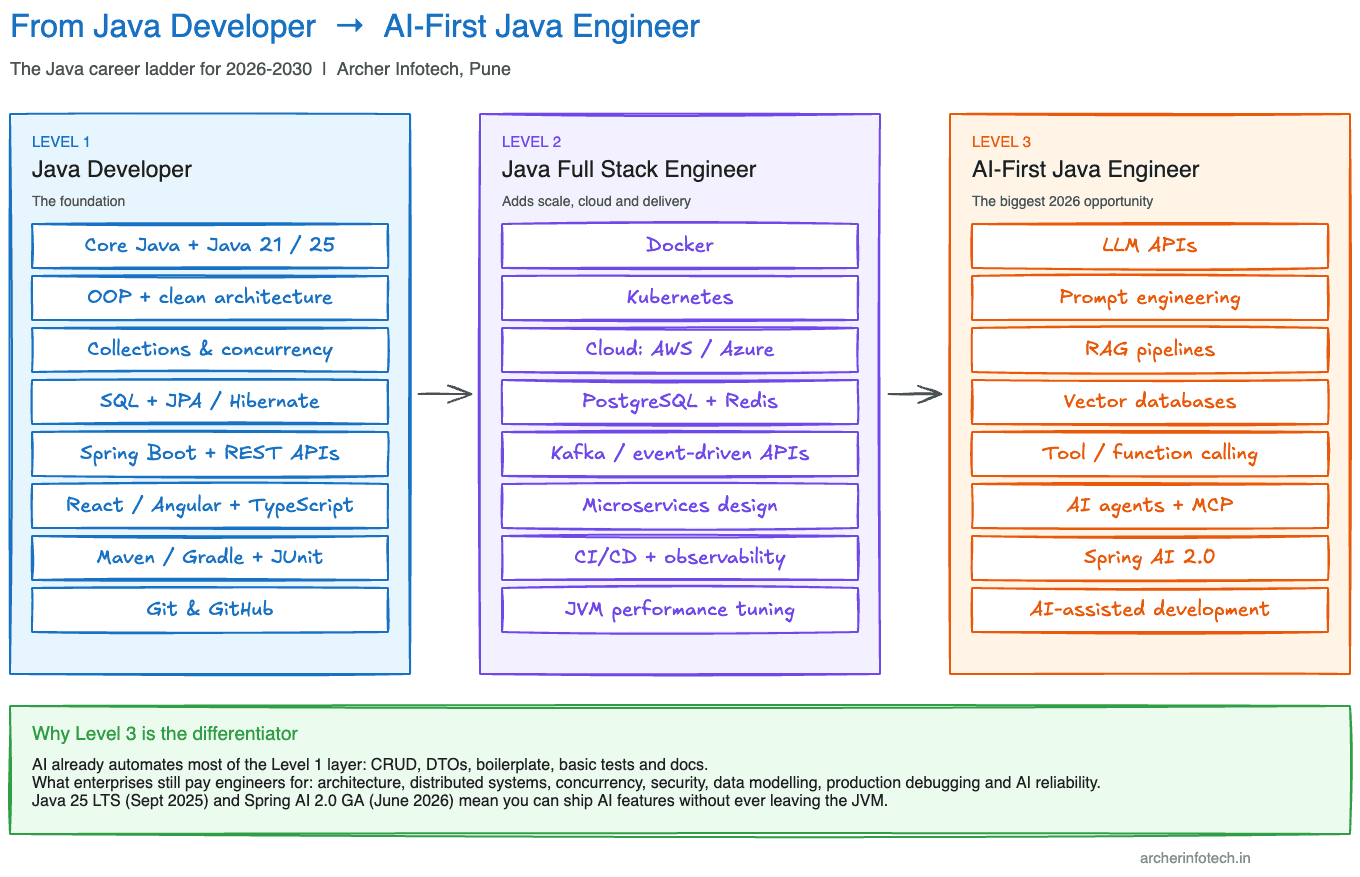
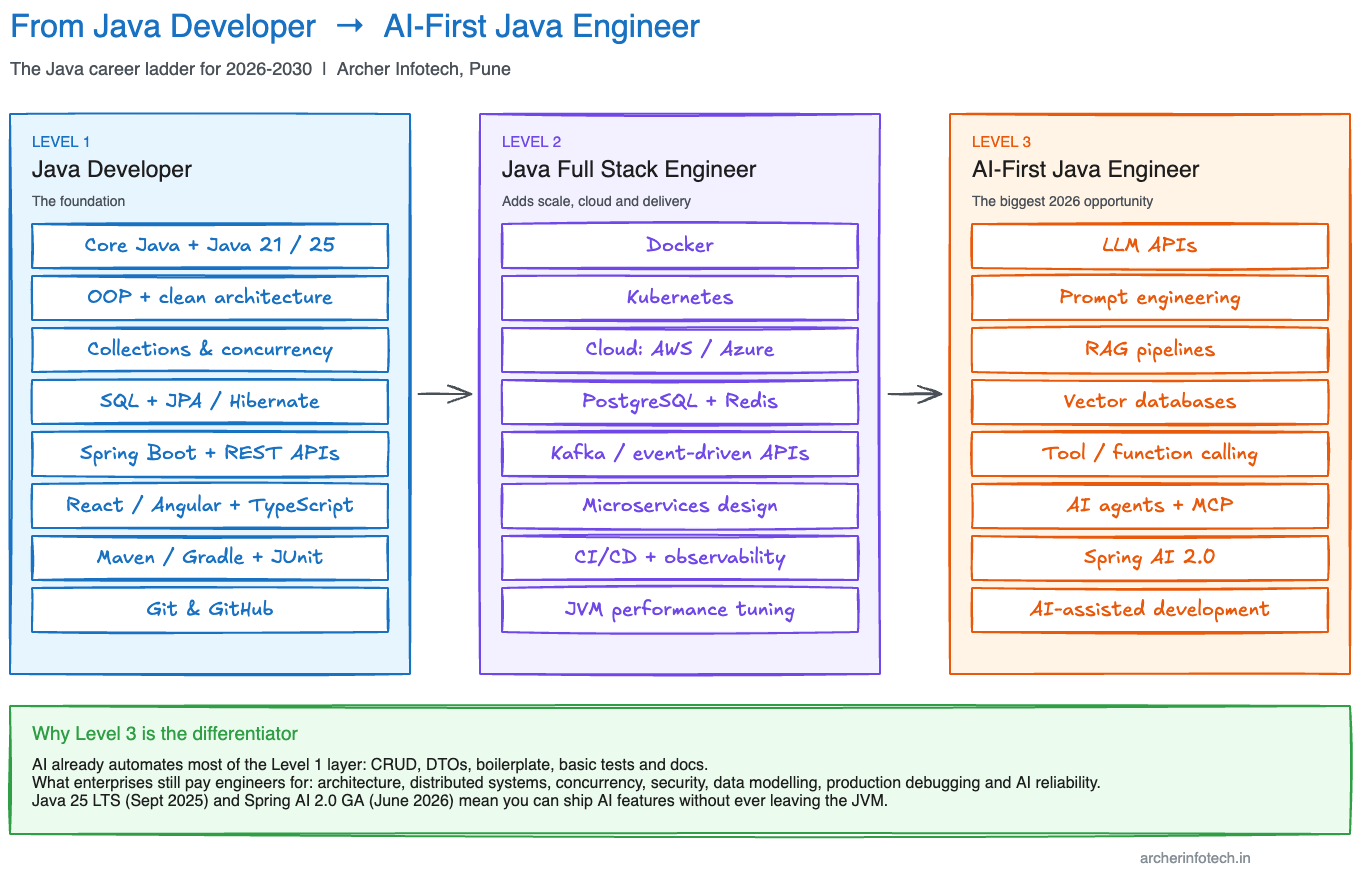
The three-level roadmap: from Java developer to AI-first Java engineer
This is how we now frame the Java career path for our students. Find your current level, then build the next one.
Level 1 — Java Developer (the foundation)
Core Java on Java 21/25 · OOP and clean architecture · collections and concurrency · SQL with JPA/Hibernate · Spring Boot and REST APIs · React or Angular with TypeScript · Maven/Gradle and JUnit · Git and GitHub.
This is the entry ticket, and it is still non-negotiable. AI can draft this layer — which is exactly why you must be able to read, judge and fix it. If you are starting here, see how long the journey realistically takes in how long it takes to learn Java in Pune.
Level 2 — Java Full Stack Engineer (scale, cloud and delivery)
Add: Docker · Kubernetes · AWS or Azure · PostgreSQL and Redis · Kafka and event-driven APIs · microservices design · CI/CD and observability · JVM performance tuning.
This is where you stop being "someone who writes Java" and become someone who can put a system into production and keep it there. Most of the ₹9–16 LPA band lives here.
Level 3 — AI-First Java Engineer (the 2026 opportunity)
Add: LLM APIs · prompt engineering · RAG pipelines · vector databases · tool and function calling · AI agents and MCP · Spring AI 2.0 · AI-assisted development workflows.
This is the layer almost nobody in the Indian Java talent pool has yet. Enterprises are actively retrofitting AI into Java estates right now, and they cannot find engineers who understand both sides. If you are choosing where to invest the next six months, invest here.
Our Java developer career path and full stack developer career path pages map each level to specific roles and salary bands, and the Pune IT career roadmap tool will sequence it for your profile.
Traditional vs AI-era Java curriculum
If you are evaluating a Java course in 2026 — anywhere, not just with us — this table is the checklist. The left column is what most syllabi still teach. The right column is what the market now pays for.
| Traditional Java syllabus | AI-era Java syllabus |
|---|---|
| Core Java (Java 8) | Modern Java 17 / 21 / 25 |
| OOP | OOP + clean architecture |
| Spring | Spring Boot |
| REST API | REST + event-driven APIs |
| Hibernate / JPA | JPA + performance optimisation |
| MySQL | PostgreSQL + Redis |
| Angular / React | React / Angular + TypeScript |
| Git | Git + GitHub workflows |
| Docker | Docker + Kubernetes |
| AWS basics | AWS / Azure |
| Manual unit testing | AI-assisted testing |
| — | Generative AI foundations |
| — | LLM APIs |
| — | RAG |
| — | Vector databases |
| — | Tool / function calling |
| — | AI agents |
| — | MCP (Model Context Protocol) |
| — | Spring AI |
| — | AI-assisted software development |
If a syllabus has nothing in the bottom nine rows, it is teaching you 2018.
So, will AI replace Java developers?
AI is far more likely to replace portions of Java development work than Java itself — or Java engineers.
The pragmatic way to think about it: AI removes roughly the bottom 30–40% of the task pyramid, the mechanical layer. That has two consequences, and only one of them is comfortable.
The uncomfortable one: the traditional path of spending your first two years writing CRUD screens to "gain experience" is closing. That work is being absorbed. Freshers now need to arrive with more than syntax.
The comfortable one: a developer who reaches Level 2 or Level 3 becomes dramatically more productive. One engineer with strong architecture judgement plus AI assistance now delivers what a team of three delivered in 2020. Companies are not reducing headcount for those people; they are competing for them.
For a wider view of how this is reshaping software roles generally, read how generative AI is changing software development careers.
What this means for you, specifically
If you are a fresher or final-year student: do not skip Level 1 to jump to AI. A "prompt engineer" with no engineering foundation is unemployable; a Java developer who also understands RAG is in demand. Build Level 1 properly, then add Level 3 selectively — one LLM-backed project in your portfolio is worth more than five CRUD apps.
If you have 2–5 years of Java experience: you are in the best position in the market and most at risk of complacency. Your Level 1 is done. Add Kubernetes, Kafka and cloud, then move straight into Spring AI and RAG. This is a six-to-nine month upgrade that repositions your entire career.
If you have 8+ years: your architecture and domain knowledge is the scarce asset, not your syntax. Pair it with AI system design — evaluation, guardrails, cost control, hallucination handling, agent reliability — and you become the person enterprises put in charge of their AI initiatives. That is a much better outcome than defending your right to write a for loop.
How we are redesigning Java Full Stack at Archer Infotech
We have trained software professionals in Pune since 2009 — over 10,000 students trained, more than 5,000 placed, a 90% placement rate, and 100+ hiring partners. We also run corporate training for teams at Amdocs, Capgemini, MindTree and Tech Mahindra, which means we see what enterprise hiring managers are actually asking for before it shows up in job descriptions.
What they are asking for changed sharply in the last eighteen months. So rather than retire Java Full Stack, we are keeping it as a flagship course and rebuilding it around:
Java 25 + Spring Boot + React + Cloud + Microservices + Generative AI + Spring AI + AI-assisted development.
The framing shift is the whole point. The question is not:
"Does Java have a future after AI?"
The question worth answering is:
"How do we turn a traditional Java developer into an AI-first Java engineer?"
That is a far stronger proposition for 2026–2030 — for a training institute, and much more importantly, for your career.
Explore the Java Full Stack Developer course in Pune, browse all full stack development courses, or talk to our team about which level you should target next.
Frequently asked questions
Is Java still worth learning in 2026?
Yes. Java 25 is an LTS release supported until at least September 2033, Java added roughly 174,700 GitHub contributors in the last Octoverse cycle, and Java remains the largest backend language by open positions in India. What has changed is the expected skill set, not the language's relevance.
Will AI replace Java developers?
AI is replacing specific tasks — CRUD generation, boilerplate, DTOs, basic tests, documentation — rather than the role. Architecture, distributed systems, concurrency, security, database design, production debugging and AI reliability remain human work, and they matter especially in the large enterprise systems where Java dominates.
Should I learn Python instead of Java for AI?
Not necessarily. Python leads in model training and research, but most enterprises are adding AI to existing Java systems rather than rewriting them. With Spring AI 2.0 GA (June 2026), a Java developer can build RAG pipelines, tool calling and agents natively on the JVM. If your goal is enterprise application development, Java plus Spring AI is the shorter path.
What is Spring AI and why does it matter for Java developers?
Spring AI is the official Spring project for building AI applications in Java. It provides a unified ChatClient API, vector store abstractions, RAG support, chat memory and tool calling across providers such as OpenAI, Anthropic, Ollama and Bedrock. Version 2.0.0 reached GA on 12 June 2026, built on Spring Boot 4.1 — which means AI is now a mainstream part of the Spring ecosystem rather than an experiment.
How long does it take to become an AI-first Java engineer?
From zero, Level 1 typically takes 5–7 months of serious study. An experienced Java developer already at Level 1 can usually reach Level 3 in six to nine months by adding cloud, containers and event-driven fundamentals first, then LLM APIs, RAG, vector databases and Spring AI.
Do I need to be good at maths to add AI skills to Java?
For application-level AI work — calling LLM APIs, building RAG pipelines, wiring tool calling and agents with Spring AI — you need no advanced mathematics. Maths becomes important only if you move into training or fine-tuning models, which is a different career track from Java application engineering.
Pune IT careers — monthly briefing
One email a month with the most actionable Pune IT hiring + salary updates. Free.
One email per month. No spam. Unsubscribe anytime.